Variable-Speed Pool Pumps: Federal Law & Energy Savings

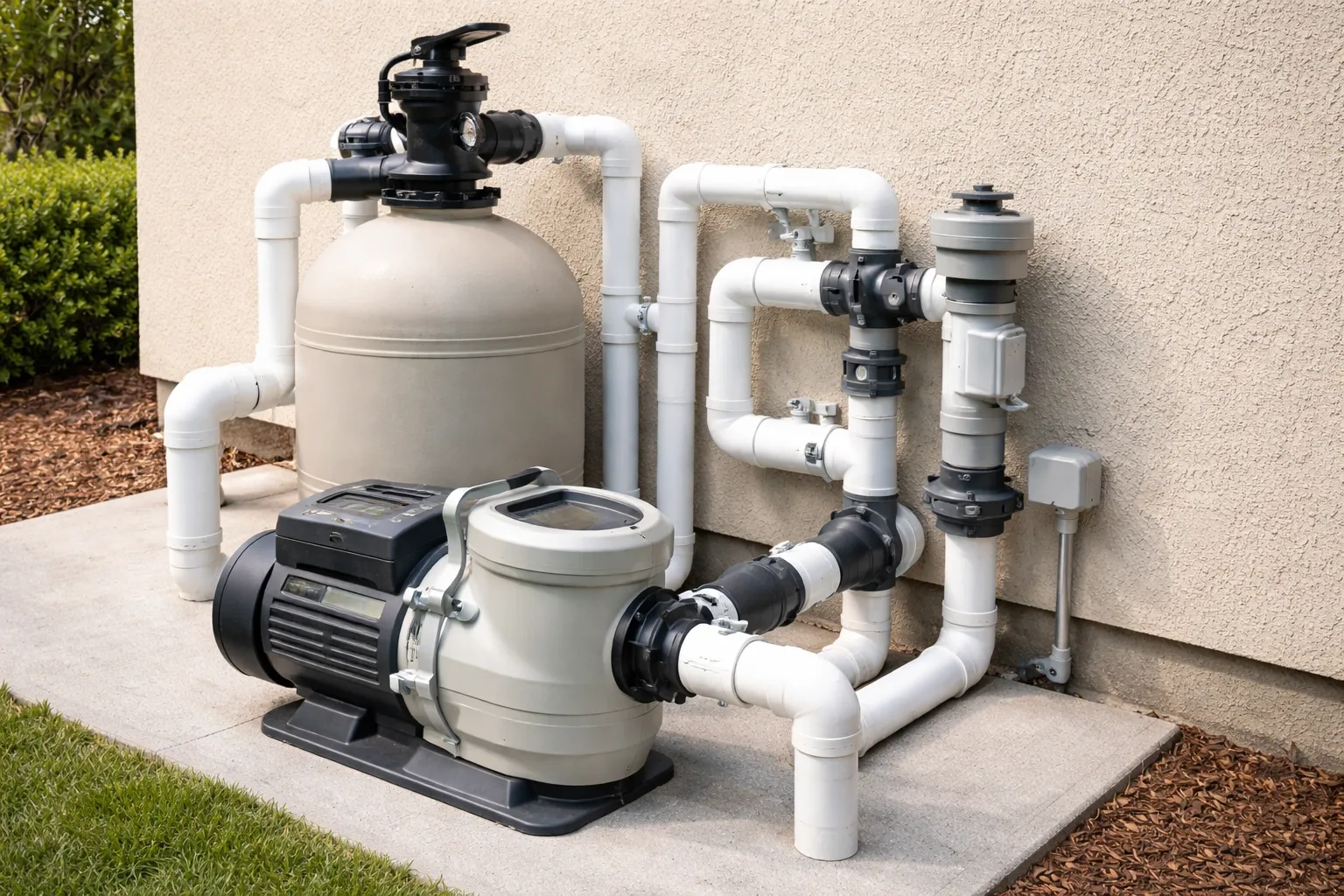
If your pool pump is approaching end of life, or if it has already failed, the replacement market changed significantly in September 2025. A federal rule from the U.S. Department of Energy took effect that prohibits the sale and installation of single-speed pool pumps above a certain size for new replacements. This isn't a state regulation you can shop around — it applies everywhere in the United States. This article explains exactly what changed, who it affects, and why the new requirements are actually good news for pool owners who understand the economics.
What the DOE Rule Actually Says
The U.S. Department of Energy's Energy Conservation Standards for Dedicated-Purpose Pool Pump Motors establish minimum efficiency requirements for residential pool pumps sold after the rule's effective dates. The rule rolled out in two phases:
- September 29, 2025: Applies to pool pumps with a Total Horsepower (THP) of 1.15 or greater. Single-speed pumps at or above this threshold may no longer be sold for residential pool use as replacements.
- September 28, 2027: Expands to cover pumps in the 0.5 to 1.15 THP range. After this date, even smaller single-speed pumps will not be legal for sale as residential pool pump replacements.
What this means in plain terms: starting September 29, 2025, if your pump is 1.15 THP or larger — which includes the majority of residential in-ground pools — you cannot legally replace it with a single-speed pump. A variable-speed or two-speed pump is the required upgrade.
Who Does This Apply To?
The rule applies to residential conventional in-ground pools. It covers pumps used for pool circulation — not dedicated spa pumps, integrally connected circulation systems on certain pool types, booster pumps for pressure-side cleaners, or a few other specific exclusions.
For the typical homeowner in Virginia or Maryland with a standard in-ground pool using a 1.5 HP or 2 HP single-speed pump, the September 2025 rule applies directly. If your pump is closer to 1 HP, you have until September 2027 before the requirement reaches you, but the efficiency math makes upgrading sooner financially compelling regardless.
It's also worth noting: this rule affects the sale of non-compliant pumps, not just installation. Pool supply retailers and distributors across the country are clearing remaining single-speed inventory ahead of these dates. After September 29, 2025, you simply won't be able to source a direct single-speed replacement for an in-ground pool pump above 1.15 THP — the product won't be available.
The Energy Savings Are Real — Not Marketing
The reason the federal government moved on this is that pool pumps are among the largest residential electricity consumers in homes that have them — second only to HVAC systems in some estimates. Traditional single-speed pumps run at 100% power all the time, even when the pool's filtration needs could be met at 25–40% of that power.
Variable-speed pumps use permanent magnet motors (the same motor type used in electric vehicles) that can run at precisely calibrated speeds. The energy savings this unlocks follows the Affinity Laws: flow is proportional to speed, but power is proportional to the cube of speed. Slowing the pump by half doesn't use half the power — it uses one-eighth the power.
In practice, a variable-speed pump programmed to run a long filtration cycle at low speed uses 80–90% less electricity per hour than a single-speed pump running at full speed for a shorter cycle. Over a 7-month swim season in the DMV — roughly April through October — the savings on a typical 20,000-gallon pool can run $800–$1,400 per year depending on local utility rates and the pump's prior usage pattern.
Variable-Speed vs. Single-Speed: Beyond Energy
Energy costs get the headline, but there are other meaningful differences between variable-speed and single-speed pumps that pool owners in Northern Virginia and Maryland consistently notice after an upgrade:
- Quieter operation: Single-speed pumps at full speed are loud — a constant mechanical drone. Variable-speed pumps running at low speed for filtration are nearly silent. This is noticeable when the pump runs in the background during outdoor gatherings.
- Longer equipment lifespan: Running at lower speeds generates less heat and less mechanical stress. Variable-speed pump motors typically outlast the single-speed motors they replace by 2–3 years, and put less wear on downstream equipment including filters, heaters, and salt cells.
- Better filtration efficiency: Counterintuitively, slower water movement through a filter produces cleaner water. High-speed flow can force fine particles through filter media that slower flow would capture. Running longer low-speed filtration cycles generally produces measurably cleaner water.
- Automation integration: Variable-speed pumps integrate directly with pool automation systems, allowing dynamic speed adjustments based on actual pool demands — higher speed during a cleaning cycle, lower speed at night, programmable speed profiles for different equipment combinations.
What It Costs to Upgrade
Variable-speed pool pumps range from approximately $600–$900 for the pump unit itself (depending on brand and horsepower) to $1,000–$1,600 installed, including labor and any related equipment modifications. Premium brand systems — Pentair IntelliFlow, Hayward EcoStar, Jandy ePump — are at the higher end of that range but have strong track records for longevity and automation compatibility.
The payback period on a variable-speed pump upgrade in the DMV market, given typical electricity rates in Virginia and Maryland, is typically 1.5–3 years. After payback, the energy savings represent pure return. Over a 10-year pump lifespan, the total cost of ownership of a variable-speed pump is dramatically lower than the single-speed alternative would have been — even setting the federal mandate aside.
Some utilities in the region have offered or historically offered rebates on variable-speed pump upgrades. It's worth checking with your electricity provider (Dominion Energy in Virginia, Pepco or BGE in Maryland) before scheduling your installation to determine whether any rebate program is currently active.
What to Do If Your Pump Is Failing Right Now
If your pump is currently failing or has already failed and you're trying to figure out your options, here's the practical guidance:
- Don't wait for total failure: A pump running in a degraded state — reduced flow, unusual noise, tripping breakers — can damage the motor, create secondary issues with the filter and heater, and leave the pool uncirculated. Address pump issues before they become emergencies.
- Have your current pump's THP confirmed: The nameplate should show horsepower (HP) and Total Horsepower. Most 1.5 HP and 2 HP pumps are at or above 1.15 THP and fall under the September 2025 rule right now.
- Choose a reputable variable-speed pump from a major manufacturer: Pentair, Hayward, and Jandy all have proven variable-speed lines. Avoid off-brand or import pumps that may not carry adequate warranty coverage or supply chains for future parts.
- Have it installed by a licensed pool professional: Variable-speed pump commissioning involves programming flow and speed parameters for your specific pool volume, plumbing configuration, and equipment set. A technician who does this regularly will optimize the settings correctly; a DIY installation often leaves significant efficiency savings on the table.
Beltway Pools Installs and Services Variable-Speed Pumps Throughout the DMV
Beltway Pools handles pump replacements, variable-speed pump installations, and automation integration for pools throughout Northern Virginia, Maryland, and DC. If your pump is aging, noisy, or already failing, our team can assess your system, specify the right replacement pump for your pool's hydraulic needs, and have it installed and commissioned correctly.
Contact our service team to schedule a pump assessment or replacement. We'll make sure your pool meets the federal standards, operates efficiently, and is protected against the kind of equipment damage that comes from running the wrong pump at the wrong speed.
Ready to get started?
Beltway Pools serves Maryland, Virginia, and Washington DC.
Explore our service & repair optionsKeep Reading
More Articles
- Service & Repairs
Why You Need a Pool Inspection When Buying or Selling a Home
Clear water doesn't mean a healthy pool. Learn what a professional pool inspection covers and why it matters for buyers and sellers in Virginia and Maryland.
Read article - Service & Repairs
How Pool Condition Affects Your Home's Value in the DMV
A pool can add serious value to a DMV home — or cost you at closing. Learn what sellers, buyers, and Realtors in Virginia and Maryland need to know.
Read article - Service & Repairs
Pool Pump Failure: Warning Signs, Causes & Repair Costs
Pool pump failure warning signs, common causes, repair vs. replacement decisions, and realistic repair costs in Virginia and Maryland — a practical guide.
Read article